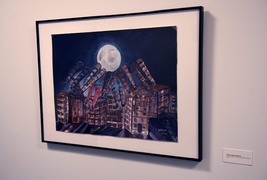
 The art is striking — a miniature three-masted ship in
cardboard, with bits of T-shirt for the sails and threads from a prayer
cap for ropes. A picture of a huge mosque at water's edge. A shadowy and
faceless Statue of Liberty.
The art is striking — a miniature three-masted ship in
cardboard, with bits of T-shirt for the sails and threads from a prayer
cap for ropes. A picture of a huge mosque at water's edge. A shadowy and
faceless Statue of Liberty.
The pieces are all part of a
surprising exhibit in New York with an unlikely source — the US
military prison at Guantanamo Bay, Cuba.
The John Jay
College of Criminal Justice is offering art lovers a chance to examine
the works of eight presumed terrorists now or once held at the detention
centre, which has become a symbol of America's “war on terror” — and of
the excesses committed in its name.
The prison was
opened in 2002 at the US naval base on Cuba's southern coast. Some 800
suspected jihadists, swept up by American forces in Afghanistan after
the September 11, 2001 terror attacks, have passed through its cells.
Former US president Barack Obama promised to close the prison amid reports of torture or arbitrary treatment.
But 41 detainees remain, and President Donald Trump, vowing a relentless war on extremists, wants to keep them there.
The
exhibit of paintings and other objets d'art made by detainees is called
“Ode to the Sea” and the water is indeed an omnipresent theme — even
though prisoners were able to see it only once.
A 2014
hurricane briefly forced the US military to remove the tarps blocking
the detainees' view, said Erin Thompson, a co-curator of the exhibit and
an assistant art professor at John Jay.
No 'glorification'
While the sea apparently fed the dreams — and the nightmares
— of detainees, it is also a theme that passes the rigorous standards
of Guantanamo censors, who have rejected some artworks as “overly
political or angry,” Thompson said.
Censors did, however, approve a drawing entitled “Vertigo at Guantanamo” — a dizzying spiral of blue, green and red dots.
Pakistani
detainee Ammar al-Baluchi, the exhibit's only artist to have been
charged formally over the 9/11 attacks, wanted to convey to his lawyers
the precarious feeling he says he has suffered since being “tortured by
the CIA,” Thompson explained.
“This art is not here to glorify him as an artist — it's here so we can learn about his experience, his life,” she said.
Of the 30 works on display, 16 come from a single detainee: Muhammad Ansi, a Yemeni.
Released
from Guantanamo and transferred to Oman in January 2017, Ansi is, in a
way, the man behind the exhibit, explained his New York lawyer, Beth
Jacob.
'Demonised'
During their first meeting, Ansi spoke to her at length
about the art courses that Guantanamo first offered in 2009, and he
asked if his work could eventually be displayed in the outside world.
Jacob
received clearance from Guantanamo officials to take a few of his works
off the island, and she showed them to artist friends in New York.
Thus
was born the idea of an exhibit. Other detainees, or former detainees
who had left Guantanamo along with their artworks, asked to take part.
These men “know they have been demonised,” Jacob said.
“What
they hope by this is that people will see them not as the worst of the
worst but as people, as humans, as people who have feelings and
emotions, who appreciate beauty, who try to create that beauty.
“It's almost a cry for understanding.”
For
other detainees, the exhibit is a chance to “reaffirm (their)
existence,” said Ramzi Kassem, a law professor at the City University of
New York, who has also represented Guantanamo detainees.
Yemeni
detainee Moath al-Alwi — the creator of the three-masted cardboard ship
— was one of the first to arrive in Guantanamo, in January 2002, after
his arrest at the Afghan-Pakistan border.
“He has seen
all these other prisoners leave, and he is still there for no real
reason. He has never been charged, never been tried, so it is a form of
disappearance, a form of erasure,” Kassem said.
'Caged bird sings'
Judging by the exhibit's guest book, visitors often leave feeling both surprised and moved.
“The caged bird sings,” wrote one who did not leave a name.
“To
be there all this time, and to be alone and just having an art class —
how important that must have been just to keep you sane,” Robert Fulmer,
a coffee importer from San Francisco, told AFP.
The exhibit has apparently caused a stir at the Pentagon, after reports that some patrons wanted to buy the works on display.
Spokesman
Benjamin Sakrisson confirmed to AFP that the release of artworks from
Guantanamo was being suspended amid a “re-examination” of the policy.
The Defence Department had not realised before the exhibit opened that works considered US property “could be sold,” he said.
Thompson
confirmed that some visitors to the exhibit, which runs through January
26, had expressed an interest in purchasing certain works.
But only those by former detainees would be made available for sale, she said.
Kassem said he feels certain the potential sales are only a pretext for the Pentagon to change course.
“The
moment these prisoners begin to express themselves, that they are able
to show that they are human beings like everyone else... that's a
threat,” Kassem said.
“It runs immediately counter to the narrative that justifies not only Gitmo but the entire war on terror.


