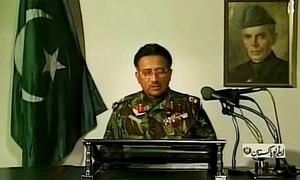
 "There
was an explosion just half-a-minute after we crossed (the bridge). I
felt the explosion in my car,” General Musharraf told PTV shortly after
escaping a daring attempt on his life on December 14. “That is all that I
know except, of course, that it was certainly a terrorist attack and
certainly it was me who was targeted.”
"There
was an explosion just half-a-minute after we crossed (the bridge). I
felt the explosion in my car,” General Musharraf told PTV shortly after
escaping a daring attempt on his life on December 14. “That is all that I
know except, of course, that it was certainly a terrorist attack and
certainly it was me who was targeted.”
General Musharraf
was targeted as he crossed the Jhanda Chichi bridge near the 10 corps
headquarters in Rawalpindi shortly after arriving from Karachi on
December 14. The Jhanda Chichi bridge had been wired with an estimated
250 kilograms of explosives, making it the most serious attempt till
then on the life of Pakistan’s military ruler.
However, a
mere 11 days later, terrorists struck again as two suicide bombers
tried to ram cars packed with explosives into the presidential convoy,
not far from the venue of the first attack. The December attacks bring
the total number of attempts on General Musharraf’s life to four. He was
first targeted in Karachi on April 26, 2003 when terrorists tried to
blow up a car parked on Shahrae Faisal as his convoy was passing by. No
one was killed in the December 14 attack while 14 including the two
suicide bombers died in the two-pronged suicide attack on December 25.
Senior government and military officials contacted by the Herald
readily admit that such a calculated series of attacks in a highly
protected military area close to the Army House and the corps
headquarters calls for a radical rethink of the president’s security.
The principal worry, these sources point out, relates to the fact that
terrorists may have regular access to top-secret information about the
general’s movement inside the country despite the fact that his
itinerary is never disclosed.
In the two previous
attempts, the suspects included an officer of the rangers and a naval
dockyard worker which means the similar involvement of low-level
government officials in the December attacks cannot be ruled out. This
obviously reflects poorly on the competence of the army’s Special
Services Group (SSG) which serves as General Musharraf’s personal
security guard. As expected, the lapse was noticed at the highest level:
on December 18, General Musharraf replaced the director-general of
military intelligence Major General Tariq Majeed with his military
secretary Major General Nadeem Taj.
Meanwhile,
preliminary investigations have thrown up some specific areas where the
security lapse was particularly appalling. Investigators argue that it
would have taken the terrorists hours to lay down 250 kilograms of
explosives under the culvert and wire them up with remote controlled
triggers. The material used to blow up the bridge is known as C4
explosives, the highest quality plastic explosives used by militaries
all over the world.
The explosive material, which can
easily be moulded into any shape, has been expertly tied to each of the
five horizontal bars on the side of the bridge that had no load bearing
pillars. And the estimate of the quantity of explosives used in the
attempt cannot be too far off the mark: the blast was so powerful that a
thick layer of reinforced concrete was literally ripped off the bridge.
It
is astonishing that they managed to do all that without being noticed
in what is primarily a military neighborhood. Interior Minister Faisal
Saleh Hayat told Parliament on December 15 that those responsible for
the president’s security were being questioned. He also said that the
main focus of investigations was on the explosives and how they were
placed under the bridge.
The panic that has hit the
president’s security staff after the two assassination attempts revolves
around the problem of creating a watertight security regime. Already,
the president is surrounded by a security protocol that can be ranked
amongst the most stringent in the world. The only predictable part is
the fact that he mostly uses the ring road to get on to the Kashmir
highway for his trips between Rawalpindi and Islamabad since it bypasses
the busier urban areas.
However, before his motorcade
sets out, hundreds of security personnel are deployed to check for any
suspicious movement or presence along the route. And bridges receive
special attention as they are obvious places for planting bombs. Besides
other security cars and ambulances that usually accompany the
presidential motorcade, a discreet force of about 20 SSG troops called
the Rapid Reaction Force follows the presidential convoy and maintains a
45-second distance from the main convoy. Intelligence sources say
General Musharraf himself decides at the last minute in which car he
will ride. Helicopters, too, are routinely used to keep a close eye on
the route.
Then there is the presidential armoured
Mercedes which is built like a fortress on wheels. No know bullet can
pierce its armour. In fact, the presidential Mercedes currently in use
has been designed to withstand even chemical and biological attacks. It
can keep running even if all the rubber is blown off its tyres and it is
surrounded by a five inch thick armour which can withstand
rocket-propelled grenades. But all these security arrangements have come
into question since the December attempts on the general’s life.
Officials close to the investigations told the Herald
that investigators are convinced the only security feature that seemed
to have worked on December 14 was the VIP-2 Bomber Ranger. It is a
highly sophisticated and extremely expensive piece of counter-terrorism
equipment, primarily meant to analyse and jam radio signals for
remote-controlled devices which seem to be the weapon of choice for most
terrorist these days. The jammer usually works by emitting a magnetic
pulse to block frequencies used for remotes as well as signals from
precision timers. It was only the 55 second delay caused by VIP-2, say
these sources, that saved the president’s life. The VIP-2 jammer is
being used in various parts of the world to protect high profile
personalities.
Given that the existing security
arrangements have proven to be inadequate—at least to the extent that
the terrorists managed to get close to the president’s cavalcade not
only once but twice- it has now been decided to install cameras on the
long and tricky Kashmir highway. A central monitoring room has been
established at the Inter Services Intelligence (ISI) headquarters to
monitor General Musharraf’s movements starting from his early morning
drive from Rawalpindi to Islamabad. To keep an eye on the long route,
which passes through some dense patches of trees around the federal
capital, the agencies have even planned installations of cameras on
trees to record every movement on the road leading to Murree and areas
around Islamabad.
In addition, the Herald learnt that the
presidential security team has also recommended the installation of the
highly sophisticated SSR 2000 Radar Imaging system to monitor the
presidential route on Kashmir highway. The SSR 2000 is an advanced
detection system which helps locate explosives and weapons even if they
are hidden inside walls, floors, cabinets and other hard-to-access
locations such as concrete walls up to 10 inches thick. The new security
protocol also includes plans to have more than one presidential
cavalcade. The idea that no one outside the cavalcade should know
exactly which car the president is travelling in, thereby minimizing
threat of an attack.
The airspace over the president’s
secretariat and the GHQ remains closed to commercial air traffic.
General Musharraf, who usually carries a pistol, wears a bullet proof
jacket with metal shock plates, built specifically to stop bullets and
other small projectiles. There are also reports that the General may
start using ‘doubles’ for extra protection. Suicide bombers pose a
particularly tricky threat and it is primarily with this in mind that
General Musharrraf has been advised to avoid showing up in public
unnecessarily and to refrain from embracing or even shaking hands with
anyone.
As far as the fears of a missile attack are
concerned, plans to equip the presidential plane with the most modern
anti-missile system are already in their final stages. This system
carries airborne laser weapon technology that can shoot down missiles
before they reach their target. The airborne laser weapon system
operates at relatively high altitudes from where it can track missiles
as they start gathering speed. As soon as it has locked on to an
incoming missile, it fires high-energy laser beams that can force
premature detonation.
Security experts say that the
threat of a missile attack on the president’s plane must not be played
down given that Pakistan has twice lost key members of its senior
military cadre in aircraft-related incidents. On August 17, 1988,
General Ziaul Haq’s C-130 aircraft went down near Bahawalpur killing
most of the army top brass as well as the then US ambassador in
Pakistan. Some 15 years later, on February 20, 2003, Air Force chief
Mushaf Ali Mir along with several senior army officers lost their lives
in yet another mysterious plane crash near Kohat. This is perhaps the
reason why US security experts were quick to recommend an anti-missile
system for the presidential aircraft when they were consulted on the
issue in the wake of 9/11.
Their suggestion was duly
approved by General Musharraf despite the high cost involved. Another
contentious issue was that of the system’s installation, as the
Pakistani’s did not have the required expertise while the general’s
security advisers were not entirely comfortable with the idea of letting
the Americans carry out the entire installation. According to the
latest reports, it has finally decided to go ahead with the anti-missile
system which is costing Pakistan an estimated 15 million dollars.
Political
observers are of the opinion that irrespective of all the additional
security measures being currently undertaken, the threat to President
Musharraf from extremists is unlikely to melt away with time. Given that
his foes are adept at using all kinds of unconventional means for
furthering their agenda, no amount of sophisticated technology can
provide cast iron guarantees for his security.
Friends turned foes
It was a combination of sophisticated technology and sheer
good luck that saved Pakistan from yet another political upheaval last
December. Security officials entrusted with investigation into the two
attempts on General Musharraf within a space of 11 days are now trying
to put together the pieces of what looks to be an extremely complicated
jigsaw puzzle.
Having examined the evidence recovered
from the scene of December 14 attack – five detonators, a control box
and the supply line leading to the explosives- investigators have
succeeded in unravelling some pieces of the puzzle. Well-placed sources
told the Herald that there is a strong possibility of the
involvement of some al-Qaeda operatives who may have been acting in
collusion with some local militant outfits.
Sources in
the Pakistani intelligence network say that the December 14 attack may
have been a follow-up of the threats hurled at General Musharraf by a
top al-qaeda leader a few months ago. Osama bin Laden’s deputy, Dr.
Ayman al- Zawahiri had called upon the Pakistani security forces to
topple General Musharraf for “betraying Islam”. This was communicated
via two separate messages aired by Arabian channels al-Jazeera and
al-Arabiya on September 10 and 28 respectively. The two channels
reported that al-Zawahiri’s message was received through an anonymous
phone call, possibly from Pakistan. Those investigating the December
attempts believe that al-Qaeda became more active in Pakistan after
al-Zawahiri’s message was aired.
According to their
information, one of the FBI’s most wanted al-Qaeda operatives, Hadi
al-Iraqi, is currently operating from the North Waziristan Agency on the
Pak-Afghan border, along with a Pakistani named Amjad Farooqi who is
wanted for his suspected involvement in the brutal murder of American
journalist Daniel Pearl. These circles believe that Hadi may have
travelled to several Pakistani cities, of late coming as far south as
the port city of Karachi.
Despite being an Arab, say
these sources, Hadi speaks fluent Pashto and some Urdu, and can easily
pass as a Pathan. As such, conclude these sources, Hadi may well have
come down to Rawalpindi to plan the December 14 attack.
Similarly,
initial investigations in the two-pronged suicide attack on General
Pervez Musharraf on December 25 have hinted at the possible involvement
of Brigade 313, a loose alliance of five militant organisations
including Jaish-e-Mohammad, Harkatul Jihad al-Islami, Lashkar-e-Taiba,
Lashkar-e-Jhangvi and Harkatul Mujahideen al-Alami. The alliance came
into being shortly after the US started to bomb Afghanistan in October
2001. The leadership of this alliance has pledged to target key
Pakistani leaders who, in its opinion, are ‘damaging the cause of jihad’
in order to ‘further the American agenda in Pakistan’.
According
to investigators, the two suicide bombers responsible for the December
25 attacks have been identified as Mohammad Jamil, a Jaish-e-Mohammad
activist from Azad Kashmir and Hazir Sultan, a Harkutul Jihad al-Islmai
operative from Afghanistan. Jamil 23, was a resident of Torarh (police
station Androot) in Poonch district of Azad Kahmir. Sources claim that
his identity was established after the detectives rummaging through the
debris came across his national identity card amidst some human remains.
Jamil, say sources, had gone to Jalalabad via Torkham in January 2001
through an Afghan cloth merchant in Azad Kashmir for the purpose of
acquiring military training. Afterwards, he moved to Kabul and started
living in the Darul Aman area on the outskirts of the Afghan capital.
However,
Mohammad Jamil was seriously injured and eventually captured by the
Northern Alliance when the latter entered Kabul after the fall of the
Taliban. He was shifted to a Kabul hospital where he remained under
treatment for 15 days. He was handed over to Pakistan under an agreement
between the Afghanistan and Pakistan governments. Jamil, along with 30
other militant, were flown to Peshawar in a military aircraft. They were
taken into custody and charged with immigration offences. But after
being interrogated in April 2002, Jamil was set free as nothing
incriminatory was found against him.
The second suicide
bomber, Hazir Sultan, 42, was affiliated with the Harkatul Jihad
al-Islami and belonged to the Panjsher valley of Afganistan.
Intelligence agencies have arrested five close aides of Hazir Sultan all
of whom have identified his body. Hazir was camped in South Waziristan
Agency and was apparently there during the Wana operation on October 2.
Investigators believe he had moved to Rawalpindi a few days prior to the
December 25 attack, apparently to finalise the plans for the
assassination attempt.
Following the identification of
Jamil and Hazir, investigators turned their attention to other
components of Brigade 313. Going through the various interrogation
reports of militants arrested earlier, they started putting the big
picture together piece by piece. The arrested leader of
Lashkar-e-Jhangvi, Akram Lahori had revealed duyring his interrogation
that over 100 members of the Harkatul Jihad al-Islami had taken oath on
the Quran in May 2002 to physically eliminate General Musharraf at any
cost. Lahori’s revelations later led to the arrest of three hard-core
Harkat activits - Mohammad Imran, Mohammad Hanif and Sheikh Mohammad
Ahmed – for their alleged involvement in the April 26 attempt on General
Musharraf in Karachi.
A day after the December 25
suicide attack in Rawalpindi, security officials also arrested Maulana
Masood Azhar’s younger brother and the deputy chief of the defunct
Jaish, Mufti Abdul Rauf, from Rawalpindi. Intelligence sources confirmed
to the Herald that Maulana Abdul Jabbar and Maulana Abdul Rauf
were being questioned to ascertain whether their factions had any
lengths with the al-Qaeda network. A manhunt has already been launched
for Maulana Masood Azhar who went into hiding after the government
re-banned his group in November 2003.
Among other things,
intelligence agencies are trying to determine the number of suicide
bombers raised by various components of Brigade 313. In this connection,
they have intensified their hunt for at least five members of
Jaish-e-Mohammad and Jamaatul Furqan suicide squads. These include Abbas
Haider of Sibi, Naeem and Safir from Bhakkar, and Adil and Tahir of
Mailsi. Five of their associates died in the year 2000 while carrying
out suicide missions in Islamabad, Murree and Taxila. These were amongst
the first major suicide missions carried out by religious militants in
Pakistan, in the wake of Pakistan’s policy shift after 9/11.
Investigators
now believe that suicide bombers pose the single largest threat to
Pakistan’s security.
Information Minister Sheikh Rashid Ahmed has made several statements
since December 25 regarding the possible identity of General Musharraf’s
would-be assassins.
According to the minister, Kashmiri
and Afghan militants may have come together in a bid to eliminate
General Musharraf. He has also described the terrorists’ network as
“huge” with its “tentacles reaching from Kashmir to Afghanistan”. Sheikh
Rashid said most of these terrorists may also have linkages outside
Pakistan. Of the five components of Brigade 313, at least one – Harkatul
Jihad al-Islami – was a purely Afghanistan-based outfit until its
leader, Qari Saifullah Akhtar, fled Kandahar when the US bombing of
Afghanistan began in October 2001.
Harkat was initially
allied to Afghan leader Nabi Mohammadi but became Kandahar’s most
prominent militant outfit following the rise of the Taliban. In the late
1990s, Harkat was credited with providing Pakistani fighters to the
Muslim militant formations fighting in Chechnya and other places in
Central Asia. Qari Akhtarleft Kandahar to settle in Pakistan where he
eventually became a member of Brigade 313.


