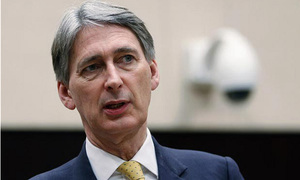
Britain's finance minister told the Chinese premier there are “many opportunities” for closer commercial ties as he started a visit Friday aimed at developing trade as the United Kingdom prepares to leave the European Union.
British leaders are looking
to China for trade and investment as they try to fashion a new global
role and offset reduced access to the European common market.
Chinese
officials believe a post-Brexit Britain needs China more than ever but
its companies are uneasy about the future of a market they see as one of
Europe's most welcoming.
Philip Hammond was in Beijing
for an annual “economic dialogue” that has taken on added significance
this year. He was accompanied by an unusually large delegation of
businesspeople and British economic officials for such an event.
Premier Li Keqiang, China's top economic official,
expressed confidence in “steady and sound growth” of Chinese-British
relations regardless of what happens between London and the EU.
“We
see many opportunities to build on our strong relationship,” said
Hammond in the meeting at the Great Hall of the People in central
Beijing, the symbolic seat of China's government.
Both
governments have declared themselves to be in a “Golden Era” of
relations. They say they want closer cooperation in finance, clean
energy, nuclear power and other fields.
Britain needs to
diversify its trade “and China is regarded as a potential replacement
for the EU in this regard,” said Wang Zhanpeng, director of the British
Studies Centre at the Beijing Foreign Studies University.
China
had hoped Britain would be a partner inside the EU, helping to resist
pressure in the bloc to restrict imports, said Wang. But he said the
uncertainty of Brexit might hurt Britain's image as a stable and
welcoming market.
“If the impact of Brexit lasts for a
long time, it may bring about negative effects on China's investment and
acquisitions in the country,” said Wang.
Total two-way
British-Chinese trade in goods last year was $49.1 billion, according to
Chinese trade data. Britain ran a deficit of $24.4 billion.
Hammond's
delegation includes Gov. Mark Carney of the Bank of England, the chief
executive of the London Stock Exchange and Britain's secretaries of
international trade and business and energy.
They are
accompanied by executives from banks Barclays, HSBC and Standard
Chartered, engineering firm Arup and British law firms.
The
sides plan to conclude agreements on more than 1 billion pounds ($1.3
billion) of trade and investment deals during the event, according to
Hammond's statement. It gave no details.
Beijing
announced in November it will allow 100 percent foreign ownership of
Chinese banks, securities firms and insurers for the first time a move
that could be boon to Britain's financial industries.
Business
groups said, however, it might be too late for foreign institutions to
get more than a sliver of a market dominated by China's state-owned
banks.
They said potential investors need to details before they can know whether that will be commercially attractive.
This weekend, the two governments also plan to discuss expanding cooperation in industrial strategy, according to Hammond.
The business and energy secretary, Greg Clark, said they would discuss cooperation in renewable energy.
Britain
also wants to talk about a possible role in Beijing's “Belt and Road
Initiative,” an ambitious project aimed at expanding trade across Asia
to Europe by building railways and other infrastructure.
British
Prime Minister Theresa May got off to a rocky start with Beijing after
taking office in 2016 when she abruptly launched a review of the Hinkley
Point C nuclear power project in which China is an investor along with
French utility EDF.
May's government later allowed the development to go ahead but China's government criticised the delay.
May
and Chinese President Xi Jinping affirmed their desire for closer ties
during a meeting in July at the gathering of leaders of Group of 20
major developed and emerging economies in Hamburg, Germany.


