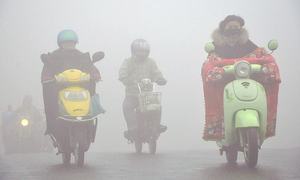
 China ended a major economic meeting on Wednesday, vowing to boost imports, open its markets and clean up noxious pollution.
The
pledges were made at the annual Central Economic Work Conference, at
which leaders review past policy and plan for the upcoming year. The
results of the three-day closed-door meetings were released by state
news agency Xinhua.
This year's meeting was set to focus
on implementing the new economic direction Chinese President Xi Jinping
outlined to the party congress in October when he declared that China
must shift from high-growth to high-quality development.
Xinhua's
reports on this week's meeting made no mention of an official growth
target for the year. But earlier on Wednesday a state think tank
forecast growth slowing to 6.7 per cent in 2018, from 6.8pc this year.
The
drive to boost imports and open China's market further could damp down a
brewing trade conflict with the United States. “China vows to increase
imports and cut import tariffs for some products to promote balanced
trade,” Xinhua reported.
The meeting also stressed the
need to “expand opening up to the outside world” and “substantially
expand market access”, Xinhua reported.
The import drive
is also a nod to the need to get China's consumer class — the meeting
noted that the country boasts the world's largest middle class — to
start spending at home.
China is counting on domestic
consumption to help rebalance its economy away from the investment-heavy
and export-dependent model that catapulted economic growth for four
decades but has left it heavily in debt.
Though many
analysts believe China's debt-dependent growth has reached a breaking
point, Xinhua's report on the meeting noted no new projects to tackle
the problem, which some economists fear could trigger a financial
crisis.
Xi has indicated he is willing to accept lower
growth as China tackles financial risk and heavy pollution, with
analysts saying he emphasised the point by leaving growth targets out of
his speech to party delegates in October.
“The key
points are to win the battle for a blue sky, adjust the industrial
structure and eliminate lagging production capacity,” Xinhua said.
This
winter China took the first steps in that direction, requiring steel
factories and smelters to cut production — with some running at half
capacity — in a drive to clean up the notoriously severe winter smog.
The
measure, among others, has dented industrial output but given the
capital a string of blue-sky days.
Along with pollution and imports, the government aims to control
financial risk, encourage renting in the housing market, reduce poverty
and protect private enterprises.


