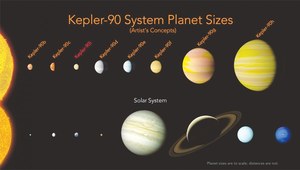
 CAPE CANAVERAL: A record-tying eighth planet has been found in a faraway solar system, matching our own in number.
Even more amazing, machines and not humans made the discovery. Nasa joined with Google on Thursday to announce the finding.
This
eighth planet orbits the star known as Kepler-90. Like Earth, this new
planet, Kepler-90i, is the third rock from its sun. But it’s much closer
to its sun orbiting in just 14 days and therefore a scorching 427
degrees Celsius at the surface. In fact, all eight planets are scrunched
up around this star, orbiting closer than Earth does to our sun.
This is the only eight-planet solar system found like ours so far tying for the most planets observed around a single star.
Our
solar system had nine planets until Pluto was demoted to a dwarf planet
in 2006 by the International Astronomical Union, a decision that still
stands. Some astronomers, however, suspect there could be a large ninth
planet out there: an elusive Planet X the size of Neptune but much
farther out.
The Kepler-90 system also could have a ninth
planet or more, according to the researchers. It is 2,545 light-years
away; a light-year is 5.8 trillion miles.
Google used
data collected by Nasa’s keen planet hunter, the Kepler Space Telescope,
to develop the machine-learning computer program. It focuses on weak
planetary signals so feeble and numerous it would take humans ages to
examine.
While machine learning has been used before in
the search for exoplanets planets beyond our solar system it’s believed
to be the first time an artificial neural network like this has been
used to find a new world.
“This is a really exciting
discovery, and we consider it to be a successful proof of concept to be
using neural networks to identify planets, even in challenging
situations where the signals are very weak,” said Christopher Shallue, a
senior software engineer at Google in Mountain View, California.
Nasa
astrophysicist Jessie Dotson, the Kepler project scientist, is “so
excited to see where this goes next.” “Who knows what potential insights
might be gained,” she said.
Shallue teamed up with
astronomer Andrew Vanderburg of the University of Texas at Austin to
develop the program. They essentially trained a computer to identify
exoplanets based on Kepler’s observations in changing stellar brightness
the subtle, fleeting dip in a star’s brightness when a planet passes in
front of it.
The two used a technique similar to what
had been previously used by others to enable machines to distinguish
between pictures of cats and dogs.
Besides identifying
Kepler-90i, the machine-learning program also confirmed an exoplanet
missed by astronomers in yet another solar system: Kepler-80g, the sixth
planet in that particular solar system.
Shallue and Vanderburg plan to keep up the hunt, using the program to scour the 150,000-plus stars observed by Kepler.
In
all, more than 3,560 exoplanets have been confirmed to date two-thirds
of them spotted by the 2009-launched Kepler with another approximately
4,500 candidates awaiting verification.


