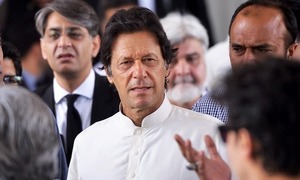
 ISLAMABAD: Justice Faisal Arab, who was a member of the three-judge Supreme Court bench that exonerated the PTI chairman on Friday,
observed in his additional note that Imran Khan did not incorporate
offshore company Niazi Services Limited (NSL) to park assets acquired
through embezzlement, bribery or tax evasion to keep them hidden from
the public eye.
ISLAMABAD: Justice Faisal Arab, who was a member of the three-judge Supreme Court bench that exonerated the PTI chairman on Friday,
observed in his additional note that Imran Khan did not incorporate
offshore company Niazi Services Limited (NSL) to park assets acquired
through embezzlement, bribery or tax evasion to keep them hidden from
the public eye.
Comparing the case of Imran Khan with
that of the Panama Papers case in which Nawaz Sharif was disqualified as
prime minister, Justice Arab observed that Mr Khan’s case was that of
acquisition of an asset from legitimate tax-paid income earned abroad
and that too at a time when he was a non-resident Pakistani holding no
public office.
“Therefore,
[Imran] Khan cannot be perceived with the same suspicion,” the note
said, adding that usually those who came to power with the intention of
indulging in financial corruption would always want offshore companies
to remain operational in order to secretively park their ill-gotten
wealth.
Referring to the reliance by PMN-N leader Hanif
Abbasi’s counsel Muhammad Akram Sheikh on the Panama Papers case,
Justice Arab recalled that in that case, serious allegations of money
laundering, corruption and possession of assets beyond known sources of
income were made against Nawaz Sharif.
Justice Arab says PTI chief’s case was acquisition of asset from legitimate tax-paid income
But the sources of acquiring several assets were not
satisfactory explained by Mr Sharif and his family members, which
included the purchase of four Avenfield flats in London, setting up of
Azizia Steel Factory in Saudi Arabia, Gulf Steel Mills in Dubai and
receiving Rs840 million on a regular basis over a period of four years
from 2011 to 2015 as gifts from an entity called Hills Metals
established in Jeddah by Nawaz Sharif, the note added.
It
said there was either total or very little explanation as to how these
assets were built, who were shareholders, what was the source of funds
and how the funds were generated, adding that considering the
high-profile office which Nawaz Sharif held over the years, accumulation
of his monthly salary from Capital FZE was considered as concealment of
an asset which led this court to hold Mr Sharif as dishonest.
The
note said that non-disclosure of unspent salary income, which had been
accumulating for a period of time, was treated as concealment of asset
in the Panama Papers case, whereas in the present case, the ownership of
London flat was disclosed by Imran Khan in his nomination form filed in
2002 general elections.
Justice Arab observed that
honesty of a person prior to his becoming a lawmaker could only be
called in question if he had accumulated wealth through fraud,
embezzlement, bribery or tax evasion and had been so declared by a
competent court of law.
Insofar his dishonesty with
regard to the assets acquired after becoming legislator, the same could
be scrutinised by the court in the proceedings in the nature of quo
warranto which would determine whether a case for acquisition of assets
beyond known sources of income was made out, the judge said.
He
observed that concealment of an asset from the public eye that was
acquired after entering upon office, for which the member was unable to
give a judicially acceptable explanation, was to be treated as an act of
concealment with dishonest intentions.
“This is the
difference in attributing dishonesty with regard to an omission to
disclose an asset acquired before and after becoming a member of the
national or a provincial assembly,” Justice Arab observed.


