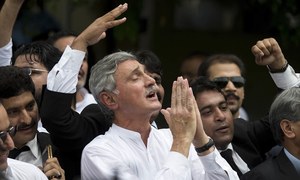
 Jahangir Tareen, considered one of the wealthiest lawmakers
of Pakistan, was disqualified on Friday by the Supreme Court from
holding public office for not being entirely truthful about the
ownership of a property in London.
Jahangir Tareen, considered one of the wealthiest lawmakers
of Pakistan, was disqualified on Friday by the Supreme Court from
holding public office for not being entirely truthful about the
ownership of a property in London.
Tareen had started his political career in 2002 after being elected to the National Assembly on a PML-Q ticket.
The
Forman Christian College alumnus had served as an advisor to former
Punjab chief minister Chaudhry Pervaiz Elahi on agriculture and new
initiatives.
In 2004, Tareen was inducted into the
federal cabinet and served as a minister with the portfolio of
industries, production and special initiatives under former president
Pervez Musharraf.
In the 2008 elections, Tareen was
re-elected as the member of the National Assembly for the second time
from NA-195 (Rahim Yar Khan – IV).
In late 2011, Tareen, who had initially planned on forming his own party of 'clean politicians', joined the Pakistan Tehreek-i-Insaf (PTI), saying that his vision was similar to that of PTI chief Imran Khan's.
Two
years later, Tareen contested ─ and lost ─ the 2013 general elections
from a seat in Lodhran district — a place he has heavily invested in in
terms of business, charity and development. However, after the Supreme
Court annulled the results of the elections citing irregularities,
Tareen defeated his opponent by a margin of over 35,000 votes in
by-polls held for the same seat.
Rift within PTI
In 2016, internal differences between Tareen — party's
secretary general — and other party members had come into the spotlight
after he became involved in a fight with the party's youth wing.
The
Insaf youth wing had demanded and printed posters calling for Tareen's
removal after he decided to dissolve the party's youth, labour and women
wings.
Later, PTI Additional General Secretary
Saifullah Niazi had resigned from his post, allegedly after developing
differences with Tareen.
Shah Mehmood Qureshi, the vice
chairman of PTI, had also openly spoken against Tareen. “The workers’
ideology will defeat the power of money,” he had said at a campaign for
intra-party elections in Lahore in November last year.
Eventually, Imran Khan had made the two shake hands and Qureshi subsequently denied saying what he said.
Money-related allegations
One of the wealthiest men in politics, owning thousands of
acres of farmland, a private plane and running some of the largest sugar
mills in the country, Tareen has remained a controversial figure during
his time in politics.
He inherited his first sugar mill
– in Rahim Yar Khan – from his father-in-law, Makhdoom Hasan Mehmood, a
prominent political figure in the 1970s and 1980s.
He
is perceived by his detractors as someone who is able to buy influence.
Tareen is known to fund many of the protests and anti-government rallies
held by the PTI, during which he is often seen standing beside Khan.
In April 2016, he admitted to having an offshore company registered in the United Kingdom in the name of his children.
The
revelation had come at a time when the PTI had begun demanding former
prime minister Nawaz Sharif's resignation in light of the Panama Papers
leak.
Allegations of money laundering and defaulted loans continued to haunt Tareen when PML-N's Hanif Abbasi filed a petition against him and Imran Khan in November the same year.
The
petition accused the two PTI leaders of not declaring their assets to
the Election Commission of Pakistan (ECP) and sought to unseat them
based on alleged violations of the lncome Tax Ordinance 1979 and the
Representation of Peoples Act 1974.
The petition also claimed that the PTI was a 'foreign funded' party.
Tareen
remained a prominent feature in the case's hearings, which started in
earnest in May 2017, as his lawyer answered the Supreme Court's
questions on his property in Britain, an offshore company, a trust
through which he allegedly bought property for his children, and his
leased land, among other things.


