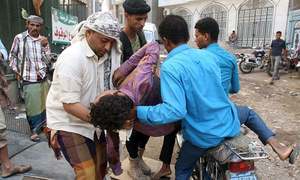
 LONDON: A record number of children were reported killed or
hurt by landmines and other explosives last year, with a handful of
conflicts contributing to a “horrific” toll for the second year running,
experts said on Thursday.
LONDON: A record number of children were reported killed or
hurt by landmines and other explosives last year, with a handful of
conflicts contributing to a “horrific” toll for the second year running,
experts said on Thursday.
The annual Landmine Monitor
report recorded 8,605 casualties in 2016, the second highest figure
since 1999 when it began gathering data.
The spike was fuelled by violence in Afghanistan, Ukraine, Yemen and Libya.
About
three-quarters of known casualties were civilians, including more than
1,000 children who were injured and nearly 500 who were killed, the
report said.
“A few intense conflicts, where utter
disregard for civilian safety persists, have resulted in very high
numbers of mine casualties for the second year in a row,” said co-editor
Loren Persi.
He described the spike as “alarming”,
adding that the true number of victims would be significantly higher due
to gaps in data from several countries, particularly Syria and Iraq.
The
toll — more than twice that recorded in 2013 — includes deaths from
improvised explosive devices, unexploded cluster munitions and other
remnants of war, as well as from mines.
Earlier this
year, Britain’s Prince Harry called for greater global efforts to rid
the world of landmines by 2025, two decades after his mother, Princess
Diana, walked through a minefield in Angola to highlight the plight of
victims.
Production and use of landmines has fallen since
the Mine Ban Treaty — which prohibits their use, stockpiling and
transfer — was adopted in 1997.
But campaigners said the
militant Islamic State group in Iraq and Syria produced improvised mines
on an “industrial scale” this year.
The report said armed groups had also used mines in at least seven other countries in the last year:
Afghanistan, India, Myanmar, Nigeria, Pakistan, Ukraine and Yemen.
Myanmar and Syria are the only countries where government forces continue to use mines, it said.
Experts
told a teleconference briefing there was evidence earlier this year
that Myanmar had laid mines along border areas where Rohingya refugees
were crossing into Bangladesh, and that there had been reports of women
and children killed.
Algeria and Mozambique both declared
themselves free of landmines in 2017, but 61 countries and disputed
regions are still known to be contaminated.
Just over half are parties to the Mine Ban Treaty, which calls for clearance of contamination within 10 years.
But experts said only four countries appeared set to meet their deadlines.
“The high number of casualties is horrific,” the Landmine and Cluster Munition Monitor’s editor Jeff Abramson said.
“States need to stay committed to reach the goal of a mine-free world by 2025.”


