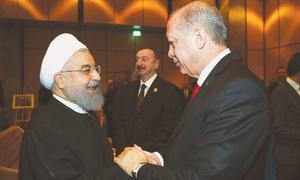
• Summit falls short of agreeing concrete sanction against Israel or US
• PM asks Washington to recommit to two-state solution
• No sign of Saudi king or crown prince as Riyadh sends foreign ministry official
• PM asks Washington to recommit to two-state solution
• No sign of Saudi king or crown prince as Riyadh sends foreign ministry official
ISTANBUL:
Islamic leaders on Wednesday urged the world to recognise occupied East
Jerusalem as the capital of Palestine, as Palestinian president Mahmoud Abbas warned the United States no longer had any role to play in the peace process.
Turkish
President Recep Tayyip Erdogan convened in Istanbul an emergency summit
of the Organisation of Islamic Cooperation (OIC) seeking a tough
response to the recognition by US President Donald Trump of Jerusalem as Israel’s capital.
With
the Islamic world itself mired in division, the summit fell well short
of agreeing any concrete sanction against Israel or the US.
But
their final statement declared “East Jerusalem as the capital of the
State of Palestine” and invited “all countries to recognise the State of
Palestine and East Jerusalem as its occupied capital”. They declared
President Trump’s decision “null and void legally” and “a deliberate
undermining of all peace efforts” that would give impetus to “extremism
and terrorism”.
The status of Jerusalem — a city holy to
Christians, Jews and Muslims — is perhaps the most sensitive issue in
the Israeli-Palestinian conflict. Israel sees the entire city as its
undivided capital, while the Palestinians want the eastern sector, which
the international community regards as annexed by Israel, as the
capital of their future state.
Mr Erdogan — who sees
himself a champion of the Palestinian cause — sought to underline his
point with a powerpoint map presentation, flashing a laser pointer at
how Palestinian territory had shrunk since the 1948 creation of Israel.
“The real proprietor of these lands is Palestine,” he told the final press conference.
“Mr
Trump wants all this to be Israel. This is the product of an evangelist
and Zionist mentality,” said Mr Erdogan, the current chair of the OIC.
‘No more role for US’
Using unusually strong language and bitterly anti-American
rhetoric, Mr Abbas warned that there could be “no peace or stability” in
the Middle East until Jerusalem is recognised as the capital of a
Palestinian state.
Moreover, he said that with Mr
Trump’s move the US had withdrawn itself from a traditional role as the
mediator in the search for Mideast peace.
“We do not
accept any role of the United States in the political process from now
on. Because it is completely biased towards Israel,” he said.
The
final statement from the OIC echoed his words, saying President Trump’s
move was “an announcement of the US administration’s withdrawal from
its role as sponsor of peace” in the Middle East.
Mr
Erdogan added that there could no longer be “any question” of the US
being a mediator. “This period is now over,” he said bluntly.
Saudi snub?
Bridging the gaps between 57 OIC member states — which
include arch rivals Saudi Arabia and Iran — was always a tall order. Key
players, like Egypt, Saudi Arabia and the United Arab Emirates, were
unlikely to want to risk their key relationship with Washington by
putting their name to anti-American measures.
Iranian
President Hassan Rouhani, Jordanian King Abdullah II and Lebanese
President Michel Aoun were among the heads of state present, as well as
the emirs of Qatar and Kuwait and presidents of Afghanistan and
Indonesia.
But there was no sign of Saudi King Salman or
his powerful crown prince and son Mohammed bin Salman, who has
reportedly been in close contact with Mr Trump over the Middle East.
Instead, Riyadh sent a senior foreign ministry official.
“Some
countries in our region are in cooperation with the United States and
the Zionist regime and determining the fate of Palestine,” seethed Mr
Rouhani, whose country does not recognise Israel and has dire relations
with Saudi Arabia.
But as the summit was being held,
King Salman echoed the calls over Jerusalem in an address in Riyadh,
saying it was the “right” of the Palestinians to establish “their
independent state with East Jerusalem as its capital”.
Sudanese
President Omar al-Bashir, who is wanted by the International Criminal
Court for genocide and war crimes, was also in attendance and warmly
greeted by Mr Erdogan. A surprise guest was Venezuela’s leftist
President Nicolas Maduro whose country has no significant Muslim
population but is a bitter critic of US policy.
Roadmap for Ummah
Speaking at the OIC summit, Pakistani Prime Minister Shahid
Khaqan Abbasi said a sovereign homeland for the Palestinian people with
Al-Quds as its capital remained the only roadmap for the Muslim Ummah
and the OIC.
“We are at the watershed moment again. The
question on every Muslim mind today would be whether we can rise above
our differences, stand united and give hope to our people, or once again
adopt declarations which cannot be translated into effective actions,”
the prime minister said.
He said the US decision was a
blatant attempt to set in motion steps to change the historic and lawful
status of the holy city, adding that Pakistan had urged the US to
rescind, fully comply with all applicable UN Security Council
resolutions and recommit unequivocally to the two-state solution.
“On
behalf of the people and government of Pakistan, I wish to reiterate
our strong condemnation of this decision,” he said and called upon the
United Nations Security Council to play its role as envisaged under the
UN Charter as its credibility would be questioned if it did not live up
to its primary role in maintaining international peace and security.
The
prime minister said Pakistan renewed its call for establishment of a
viable, independent and contiguous State of Palestine, on the basis of
international parameters, the pre-1967 borders, and with Al- Quds as its
capital.
President Trump’s announcement last week
prompted an outpouring of anger in the Muslim and Arab world, where tens
of thousands of people took to the streets to denounce the Jewish state
and show solidarity with the Palestinians.
The decision
sparked protests in Palestinian territories, with four Palestinians
killed so far in clashes or Israeli air strikes in response to rocket
fire from Gaza and hundreds wounded.


