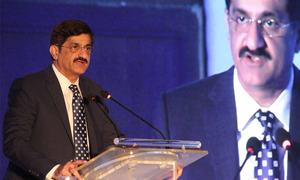
 KARACHI: The country is unprepared for the challenges and
opportunities offered by the ongoing Fourth Industrial Revolution (4IR),
speakers said at a summit that the women committee of the Institute of
Chartered Accountants of Pakistan (ICAP) organised with support from the
World Bank Group on Thursday.
KARACHI: The country is unprepared for the challenges and
opportunities offered by the ongoing Fourth Industrial Revolution (4IR),
speakers said at a summit that the women committee of the Institute of
Chartered Accountants of Pakistan (ICAP) organised with support from the
World Bank Group on Thursday.
But the country must
control its population and hone the technical skills of its human
resources, particularly women, to avail the full potential and economic
rewards of this phase of industrialisation, they said.
The
event description piqued the interest of many of those in attendance,
as it aimed to provide an insight into 4IR, how fast the world is
changing and its impact on our lives, the risk of losing out on jobs
once automation takes over, and how artificial intelligence, big data
and the internet of things may unleash or harm the potential of the
human mind.
4IR can be defined as an era in which
emerging technologies and digitisation are impacting life in an
unprecedented and unanticipated manner.
Speaking on the
occasion, Sindh Chief Minister Syed Murad Ali Shah said the provincial
government was focused on introducing digitisation and newer
technologies to enable women in businesses. “We can see how 4IR is
having an impact on our daily lives with all the latest technological
advancements,” he said. “All departmental activities and the monitoring
of projects are on my iPad,” he added.
The chief minister
said the finance department’s allocation and disbursement were
considered a state secret until a few years back. “But now, all the
record is available online with quarterly updates. Some 15,000 employees
of the Sindh government are currently being trained in the IT sector,”
he said.
In her video-linked address, World Bank Chief
Financial Management Officer and Director Policy and Country Services
Jennifer K. Thomson stressed the need for creating awareness among women
about the accounting profession and highlighted the challenges they
face in the digital age.
There is a need for more inclusivity and visibility for women through trainings and workshops, she said.
World
Bank Country Director Patchamuthu Illangovan noted that Pakistan has
two pathways to 2047. In the best-case scenario, it must join 4IR, close
the digital divide and invest in its human capital by controlling
population and reducing stunting. For that, Pakistan needs to invest in
education and health care and attain eight per cent GDP growth while
moderating its population growth between 0.8pc and 1pc, he said.
In
the worst-case scenario, the country could continue with its population
explosion and slow growth and “over the next 30 years, a generation and
a half won’t benefit from the prosperity,” he said.
In
his speech, UN Committee on Science, Technology and Innovation Chairman
Atta-ur-Rahman called for taking advantage of 4IR through a
knowledge-based approach.
He apprised the participants of
technological advancements taking place around the world and called for
further investment in the education sector to become a vibrant part of
4IR.
Habib Bank Ltd Technology Strategy Head Aamir Matin
said the banking industry is able to adopt and adapt to fintech. “In our
industry, there is a lot of regulation and a small start-up would be
unlikely. But more likely, there would be an innovative idea, which
could be partnered and supported by banks,” he said.
Pakistan
Software Houses Association President Jehan Ara said Wamda Capital
would invest $30 million in Pakistan in the next four years while Golden
Gate Ventures was also in talks for a potential investment.
Participants
were amazed when a young kid, Mohammad Mustafa, was introduced with a
made-in-Pakistan prosthetic arm. From being bullied by kids at school
due to a missing limb to finding new friends after he was fitted with a
robotic arm by a local firm Bioniks, his life changed and his confidence
soared.


