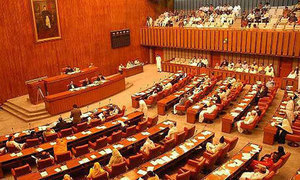
 ISLAMABAD: In a significant move towards averting the threat
of delayed general elections, the Senate on Tuesday finally passed a
bill providing for delimitation of constituencies on the basis of
provisional census results.
ISLAMABAD: In a significant move towards averting the threat
of delayed general elections, the Senate on Tuesday finally passed a
bill providing for delimitation of constituencies on the basis of
provisional census results.
As many as 84 senators voted
in favour of the bill. Kamil Ali Agha of the Pakistan Muslim
League-Quaid was the only senator who voted against the bill, while the
party’s parliamentary leader Mushahid Hussain Sayed entered the house
only after the voting process.
In a brief chat with
reporters, Mr Hussain, however, claimed that he had supported the bill.
He referred to an agreement reached during a meeting of parliamentary
leaders with Prime Minister Shahid Khaqan Abbasi and said it would not
have been possible without the role played by him and Senator Mir Hasil
Bizenjo of the National Party.
When contacted, Senator
Agha said he had acted in accordance with the party policy. He said his
presence in the house at the time of voting was meaningful. “I had been
assigned the duty to remain present in the house,” he said, adding that a
lawmaker who failed to follow party policy in voting on a
constitutional amendment was disqualified for ‘floor-crossing’.
PML-Q lawmaker votes against bill; seven Fata senators stay away from process
Saleh Shah was the only senator from the Federally
Administered Tribal Areas who voted in favour of the bill, while the
rest of seven chose to stay away from the process. Interestingly, the
Fata senators were present in the house much before the commencement of
Chief of the Army Staff General Qamar Javed Bajwa’s briefing to the
Senate Committee of the Whole.
Leader of the House in
the Senate Raja Zafarul Haq said the passage of the constitutional
amendment bill was essential for democracy and staving off the threats
to Pakistan. This, he acknowledged, was not possible without cooperation
of the opposition and thanked Leader of the Opposition in the Senate
Barrister Aitzaz Ahsan and other parliamentary leaders for their
cooperation.
Mr Haq assured the house that the points
given by Pakistan Peoples Party’s parliamentary leader Senator Taj
Haider on the modus operandi of a third-party audit of provisional
results in five per cent census blocks would be implemented in letter
and spirit.
The stand-off over the bill had been
continuing for weeks as the PPP, which had supported the bill in the
National Assembly, abruptly changed its position. Initially, the PPP was
demanding re-audit of census results in 1pc blocks, which had been
agreed at the forum of Council of Common Interests (CCI). But the party
demanded that the blocks be raised to 5pc when the bill was presented in
the National Assembly on Nov 16.
When that demand too
was met, the PPP had raised objections to the proposed modus operandi
for the re-audit exercise. The position taken by the PPP and refusal of
the government to meet the demands led to a deadlock which was broken
last Friday, when a meeting of the parliamentary leaders was convened by
the prime minister where PPP’s all demands were met. The meeting had
decided to introduce and pass the bill from the Senate on Dec 19
(Tuesday).
The bill is set to become an act of
parliament any moment after a formal assent by the president. The bill
also provides for reallocation of National Assembly seats.
Article
51(5) of the Constitution provides that seats in the National Assembly
shall be allocated to each province, Fata and the federal capital on the
basis of population in accordance with the last census officially
published.
There is a consensus among political parties
that for purposes of the next general elections to be held in 2018 and
by-elections, allocation of NA seats should be made on the basis of
provisional results of the 2017 census without changing the existing
number of general seats (272) and women seats (60) and retaining the
share of Fata (12).
According to the reallocation of
seats under the bill, seats will increase for Balochistan (2 general
seats + l woman seat), Khyber Pakhtunkhwa (4+l) and federal capital
(l+0), while seats for Punjab will decrease (-7 and -2). The seats for
Sindh will remain the same.


