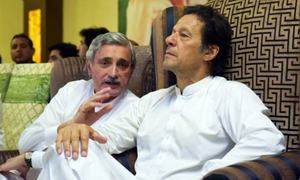
As Jahangir Tareen heads back to the pavilion and Imran Khan basks in the glow of the Supreme Court's 'not out' decision, Dawn.com breaks down each of the charges brought against the two Pakistan Tehreek-i-Insaf (PTI) leaders and how the Supreme Court reacted to each of them.
The case against the PTI
Charge No.1: PTI is a foreign-funded political party.
The verdict: Petitioner Hanif Abbasi had no business bringing this charge against the PTI.
The
Supreme Court ruled that the charge could only be presented by the
federal government for its validation on a reference made to the Supreme
Court.
The court said Abbasi thus had no locus standi
— the right to level this charge; therefore, the matter would be sent
back to the Election Commission of Pakistan (ECP) for investigation.
"The
ECP must act transparently, fairly and justly, without discrimination
among different political parties," wrote the chief justice.
"For
undertaking such scrutiny, it shall be reasonable for the ECP to
examine the accounts of a political party within five years of the
objected accounts of that party having been published in the official
gazette."
Charge No.2: The PTI's asset certificates have been falsified.
The verdict: This charge is quite irrelevant at this stage.
The
Supreme Court ruled that this could only be determined in a competent
court of law after the ECP gives its findings on whether any prohibited
funding has been received or collected by the PTI.
The case against Imran Khan
Charge No. 1: Imran Khan had an offshore company (asset) which he failed to disclose in his nomination papers.
The verdict: Niazi Services (NSL) was not an 'asset' which Khan needed to declare.
Yes,
NSL was an offshore company, of which Imran Khan was the beneficial
owner. However, the court ruled, it had been established solely as a
corporate vehicle for the legal ownership of Khan's London flat and
Imran Khan could not be proved to have been a shareholder or a director
of NSL.
The court noted that Imran Khan had later
declared the London flat through an amnesty scheme under Pakistan's
income tax laws, after which there was no need left to also declare NSL —
which had only been set up to buy the flat — as an asset in his income
tax returns, statement of assets or annual returns.
Charge No. 2: Imran Khan can not justify how he acquired the funds for his Bani Gala property, hence he is dishonest.
The verdict: Khan was actually quite forthcoming about where the money came from.
The
court said it was quite satisfied that the initial purchase price of
Rs43.5 million of the Bani Gala property was paid partly by Imran Khan
(Rs7.3 million) and partly by Jemima Goldsmith (Rs36.2 million) at the
time of its purchase.
The amount was covered by foreign
currency remittances made by Imran Khan's ex-wife, the court found,
which was later returned by Imran Khan in 2003 after he sold his London
flat.
Charge No.3: Imran Khan did not legally come into ownership of the Bani Gala property
The verdict: The petitioner should mind his own business.
The
court stated unequivocally that the Bani Gala property is owned by
Imran Khan after it was orally gifted to him by his ex-wife after their
divorce.
Prior to that, the property had been acquired
by Khan for his family and the money provided by his then wife had been
more than refunded by him, the court ruled.
Therefore,
the court said, there was nothing irregular in Khan's ownership of the
property and, in any case, Hanif Abbasi had no grounds to challenge the
gift transaction between a husband and wife.
Charge No.4: Imran Khan owns a flat on 1, Constitution Avenue that he did not declare in his asset statement, hence he is dishonest.
The verdict: "There is no dishonesty in the omission made by him."
The
court found that Imran Khan had actually declared his advance payment
made to 1-Constitution Avenue Tower, Islamabad in his statement of
assets and liabilities filed with his income tax return in the tax year
2014.
He was allotted the flat in the following year,
and thereafter declared it in both his assets and liabilities statements
filed with his income tax returns for the year, as well as his annual
returns order filed with the ECP.
"Therefore, we hold
that no misdeclaration of assets was committed by Imran Khan in relation
to the said property in his annual return filed with the ECP in the
year 2014," the court ruled.
The case against Jahangir Tareen
Charge No.1: Jahangir Tareen is a dishonest person because he was involved in insider trading in the past.
The verdict: The SECP has already buried the matter through a settlement.
Though
the Supreme Court concedes that Tareen may have committed the crime of
insider trading, the court also notes that he returned his gains along
with fines, penalties and charges to the Securities and Exchange
Commission of Pakistan (SECP) as was demanded from him by the SECP.
Further,
the court noted that under the terms of the settlement with the SECP,
Tareen could not be deemed to have committed an offense just because he
agreed to a settlement.
Further, because the SECP itself
had said that the matter "will stand disposed off with no further
action" if Tareen agreed to the settlement — which he did — the court
could no longer judge Tareen on the matter.
The court
also noted that the SECP had never criminally prosecuted Tareen, which
meant that this was "a past and closed transaction."
Charge No.2: Jahangir Tareen is dishonest because he mis-declared and underpaid his agricultural income tax in 2010 and 2011.
The verdict: This is already a sub judice matter.
"We
are not persuaded to make any declaration against the respondent in
this context because the matter whether inaccurate declaration has been
made by the respondent, either in respect of agricultural income tax
before the concerned department [...] or before the Federal Board of
Revenue, is a matter which is sub-judice before different forums in the
income tax hierarchy and even before this court," the court reasoned.
"Besides,
no action so far for the alleged misdeclaration or short payment has
been taken against the respondent by the authorities under the Act of
1997," therefore Tareen cannot yet be judged to be a dishonest man, the
court ruled.
Charge No.3: Jahangir Tareen got his company's loans written off by abusing his authority as a public figure, hence he is dishonest.
The verdict: That is incorrect.
The
court was not convinced that Tareen had misused his authority to have
any loans written off. The company in question that Tareen was said to
have benefited, FPML, was actually found to have had its loans written
off before 2010 — when Tareen was neither a shareholder nor a director
of the company.
"He became the shareholder and director
with effect from 29.12.2010 to 4.2.2013 and during this period no loans
were written-off," the court noted.
Charge No.4: Jahangir Tareen was
the owner of a property in the UK which he had not declared in his
nomination papers, hence he had been dishonest.
The verdict: Guilty!
"We
hold that Shiny View Limited (SVL), an off-shore company, was
established by the respondent which has legal title of the property
measuring 12 acres known as “Hyde House” but the actual, true, real and
beneficial owner of the said property is the respondent," ruled the
court.
"Respondent has sent around more than Rs500
million at the exchange rate prevalent at that time and claims that
amount to have been utilized for the purposes of purchase and
construction of “Hyde House”.
"SVL or Hyde House was
never transferred to any trust by the respondent, thus, it is his asset,
which he has failed to declare in his nomination papers filed on
9.9.2015 according to the mandate of the law to contest the by-elections
from NA-154 Lodhran and, therefore, he is not honest in terms of
Article 62(1)(f) of the Constitution read with Section 99(1)(f) of
ROPA."
"Besides, in his concise statement the respondent
in unequivocal, clear and unambiguous terms stated that he has no
beneficial interest in the trust arrangement which holds the SVL and the
Hyde House, however from the trust deed dated 5.5.2011, on which
reliance has been placed by the respondent himself, he is the
‘discretionary lifetime beneficiary’ along with his spouse and,
therefore, this is a blatant misstatement on the part of the respondent
made before the highest judicial forum of the country which is not a
trait of an honest person."
"Consequently, on both
the counts mentioned above, the respondent is declared not to be an
honest person in terms of the constitutional provisions and the
provisions of ROPA, therefore, he ceases to be the member of the
Parliament having incurred the disqualification."


