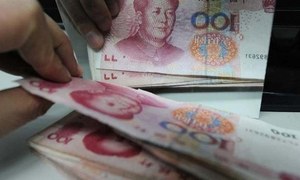
 THE recent announcement by Planning Minister Ahsan Iqbal
that all trade between China and Pakistan will now be settled in local
currency, whether the Pakistani rupee or Chinese yuan, has raised some
interesting questions. A swap arrangement between China and Pakistan was
signed on Dec 31, 2011. Explaining the purpose of that arrangement,
then governor of the State Bank of Pakistan, Yaseen Anwer, said “the
principal objective of these swaps is to promote the use of regional
currencies for trade settlement purposes” as well as advancing China’s
aim of making the yuan into an international currency.
THE recent announcement by Planning Minister Ahsan Iqbal
that all trade between China and Pakistan will now be settled in local
currency, whether the Pakistani rupee or Chinese yuan, has raised some
interesting questions. A swap arrangement between China and Pakistan was
signed on Dec 31, 2011. Explaining the purpose of that arrangement,
then governor of the State Bank of Pakistan, Yaseen Anwer, said “the
principal objective of these swaps is to promote the use of regional
currencies for trade settlement purposes” as well as advancing China’s
aim of making the yuan into an international currency.
The
size of the swap was 10 billion yuan from the Chinese side, and Rs140
billion from Pakistan ($1.6bn). Importers and exporters could now use
the facility to settle their trade in the currency of both countries,
instead of relying on US dollars, where a conversion fee would attach an
extra cost. But in the years since its launch, the facility was rarely
used by traders. Its biggest utilisation came in 2013, when the State
Bank used it to draw $600 million to help the government tide over an
emerging balance of payments crisis just long enough to get past the
elections.
So when Ahsan Iqbal chose the occasion of the
launch of the CPEC Long Term Plan to announce that “we are examining
the use of RMB instead of the US dollar for trade between the two
countries”, the first reaction amongst those who follow financial
developments between Pakistan and China was: what is there to examine? A
mechanism to do exactly this has existed for six years now.
Amongst
those asking this question is Salim Raza, former governor of the State
Bank. “I’m puzzled by the announcement,” he says. “It is not clear what
exactly is being asked by the Chinese here, perhaps they’re just urging
us to start using the swap arrangement, or perhaps they have asked for
more” than just settlement of bilateral trade in local currency.
So
long as the use of the yuan is restricted to settlement of
trade-related payments, it has little impact on Pakistan’s economy. The
fact that Pakistan runs a large and persistent deficit in its bilateral
trade with China means that the supply of yuan will continuously need to
be replenished, either through borrowing or through an expansion of the
swap arrangement, or a combination of both.
Since the
signing of the swap arrangement, Pakistan’s bilateral trade deficit with
China has more than tripled, going from $4bn to more than $12bn today.
Imports from China were $14bn last fiscal year, whereas exports stood at
$1.5bn.
“If this is to extend beyond trade-related
payments,” says Mr Raza, “then we have to be mindful. If it extends to
commercial banking, or payment for services in the local market, then it
runs the risk of introducing a parallel currency.”
In
the fall of 2008, then finance minister Shaukat Tarin travelled to China
as Pakistan was in the midst of a large balance of payments crisis of
the sort that have episodically afflicted the economy. He returned
bearing $500m as balance of payments support from the Chinese
government, along with a missive from them, saying “we don’t usually do
this sort of thing”.
To him, the proposal of conducting
bilateral trade in local currency is a good one, “provided they are
willing to commit to advance placement of yuan within Pakistan to
support the move”, he says.
A high-level source in the
Planning Commission, who could not speak for attribution, could only say
that the proposal is still at an early stage and has some way to go
before it is finalised. The Long Term Plan of CPEC, under which the
proposal is being advanced, specifically mentions tripling the size of
the swap arrangement to 30bn yuan in order to facilitate local currency
settlement of all trade transactions.
China has been on
an accelerating drive to globalise its currency for many years now. It
has sought to encourage the use of the yuan as a reserve asset, meaning
central banks of other countries can hold their foreign exchange
reserves in yuan rather than dollars. It made a strong bid to include
the yuan in the IMF’s basket of Strategic Drawing Rights (SDR), the
currency the fund uses for its lending operations. But its strongest
push towards the goal of globalising its currency has come in the form
of massive swap arrangements with central banks of more than 30
countries around the world, totaling almost $490bn according to
Bloomberg.
There is little data on how much these swaps
have actually been drawn down though. Perhaps it is its reliance on
Letters of Credit as the only mechanism to effect payment that serves as
a disincentive for many traders to use the swap, since importers of
Chinese goods rely on other channels to make payment. But how exactly
the proposal will be effected, and how it will plug the persistent
shortage of yuan in local foreign exchange markets, remain central
questions as it moves forward.


