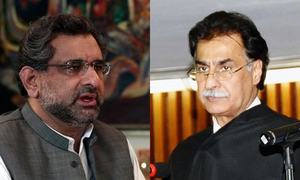
 IS the PML-N at war with itself, with state institutions or simply in disarray?
Prime Minister Shahid Khaqan Abbasi has contradicted speaker of the National Assembly Ayaz Sadiq and insisted that elections will be held on time in August. On Wednesday, Mr Sadiq ominously suggested in interviews that the National Assembly is unlikely to complete its term, though the speaker only alluded to the reasons why that may be the case.
Prime
Minister Abbasi’s rebuttal, however, is far from convincing. Travelling
yet again to London to meet PML-N supremo and ousted prime minister
Nawaz Sharif, Mr Abbasi’s words may have been more persuasive if uttered
from the floor of parliament.
The very fact that Mr
Abbasi needs to consult his party boss in a foreign land so frequently
suggests a fluidity in national politics that is the opposite of what
the prime minister has been claiming.
One of the more
puzzling aspects of the latest contradictory statements by the PML-N
leaders is that both Mr Abbasi and Mr Sadiq have been loyal supporters
of Mr Sharif. While it is possible that the prime minister and the
speaker have different views on the events unfolding, could it be a case
of Mr Sharif deploying different party leaders to spread different
messages?
A great deal of the uncertainty in national
politics today flows from Mr Sharif’s ambiguousness about his own future
in politics. Is the ousted prime minister willing to give up front-line
politics if his legal troubles become insurmountable? Or is he
determined to try and force his way back into electoral politics come
what may?
Currently, Mr Sharif is unable even to
guarantee his physical presence in Pakistan for longer than fleeting
court appearances. The illness of his wife and MNA-elect, Kulsum Nawaz,
is a legitimate factor, but there is a sense that Mr Sharif simply
prefers to be outside Pakistan for longer than is strictly necessary.
That itself is a disservice to the people and politics of Pakistan.
Certainly,
the PML-N is being subjected to pressure on a number of fronts that
mature democracies do not have to contend with. Yet, while the details
may differ, there is nothing fundamentally different about the final
year of a government being mired in political speculation and confusion.
The fifth year of the last PPP-led government was similarly turbulent.
Some
of the confusion can be dispelled by decisive leadership. Resolving the
deadlock over the census and subsequent delimitation of constituencies;
announcing a schedule for Senate elections well in advance; placing on
the record a parliamentary agenda for the last six months that focuses
on institution building and democracy strengthening — the government has
several options to nudge the political discourse away from
destabilising speculation and towards substantive governance. Prime
Minister Abbasi and Speaker Sadiq can surely do better than stir
controversy and sow confusion.


