 KARACHI: “The Japan Fest 2017 is open for you to experience a
taste of Japan by sampling our food which you have not tasted in any
restaurant here, witness our tea ceremony, and appreciate our literature
and the arts of origami, ikebana and bonsai,” said Mr Toshikazu
Isomura, the Consul General of Japan in Karachi at the start of the fest
at a local hotel here on Thursday.
KARACHI: “The Japan Fest 2017 is open for you to experience a
taste of Japan by sampling our food which you have not tasted in any
restaurant here, witness our tea ceremony, and appreciate our literature
and the arts of origami, ikebana and bonsai,” said Mr Toshikazu
Isomura, the Consul General of Japan in Karachi at the start of the fest
at a local hotel here on Thursday.
The programme,
organised by the Consulate General of Japan, had students and leading
political, business, cultural and diplomatic figures in attendance.
The
students also took part in presentations to share several cultural and
social images of Japan when they visited there earlier this year as part
of a cultural exchange programme known as Japan-East Asia Network of
Exchange for Students and Youths (Jenesys).
“The first view of Rainbow Bridge left me breathless,” said Zobia, who visited Tokyo in January this year.
Other students spoke of the resilience of the Japanese people which helps them bounce back every time.
Sadiq,
another student, who had the opportunity of visiting Nagasaki, said
Japan was an empire brought down to its knees. “But the Japanese learnt
to stand up again,” he said.
The students, especially, enjoyed their stay with different Japanese families for two days during their visit.
They
said that despite the language barrier they were able to communicate
very well, going shopping and enjoying peanut ice cream, etc.
The people who had set up stalls around the hall also came up to speak one by one.
Khurram
Sohail of Pakistan Japan Literature Forum (PJLF) spoke about how the
Japanese are committed to introduce their people to the rich literature
of other countries.
“The Diwan-i-Ghalib, collections of Mir and Manto have been translated into Japanese,” he informed.
He
praised the Japanese for their rich culture and traditions where elders
were respected, for their traditional attire and practices.
Tradition & technology
“But
that’s not all. With so much tradition on one side, there is also
technology on the other side. Japan is where tradition and technology
meet,” he said.
Usman Riaz of Mano Animation Studios
spoke about Japanese animation and how his love for it made him found
the studios and his forthcoming directorial venture, Pakistan’s first
animated feature film Sheesha Ghar. A four-minute preview of the film
was also screened at the fest.
A Rakugo performance,
where one person tells a story with the help of just two props — a
Japanese fan and a handkerchief — had Fahad Zaki tell the story ‘Zoo’.
A cosplay had many students dress up as famous characters, the best of which were also awarded.
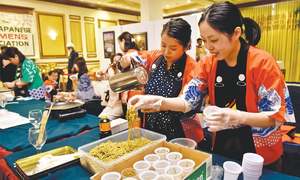
The
food offered by Japanese ladies dressed in pretty traditional attire
had many guests out of their seats to sample the delicacies.
Others
found themselves at the various activity booths. There were
opportunities to learn origami, to appreciate the stamps collections,
the little bonsai trees and the ikebana arrangements.
Later,
during the evening event of the fest there were also the koto and
shamisen performance by a Japanese artist Ms Sumie Kaneko.
Koto
is a traditional Japanese instrument with 13 strings strung across 13
movable bridges along the length of the instrument. Shamisen is a
three-stringed instrument from ancient China.
Ms Kaneko
is an accomplished koto and shamisen player, jazz singer and songwriter
who has received her training at the prestigious Tokyo National
University of Fine Arts and Music and Berklee College of Music. She has
the honour of performing at the Washington DC Jazz Festival, Carnegie
Hall, Lincoln Centre and Blue Note, New York.
Finally,
the consul general of Japan in Karachi appreciated the 65-year
Japan-Pakistan friendship and expressed his wishes to further strengthen
the existing cultural, economic and business ties between the two
countries.


