 BRUSSELS: What a difference a year makes.
A
year ago, British Prime Minister Theresa May was pictured standing alone
at an EU summit, nervously playing with her sleeve as other leaders
embraced and chatted around her — an image that summed up her isolation
after her country voted for Brexit.
On Thursday, with
the leaders of the other 27 states poised to agree to move Brexit talks
forward to the decisive phase of discussing future ties, the 61-year-old
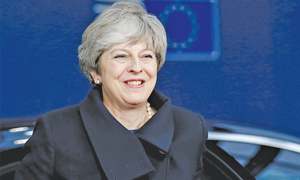
was greeted with a warm show of support.
She needs it:
the second phase of talks is likely to be even more difficult than the
first and could widen divisions in her government, her party and the
country over what Britain should become after Brexit.
May
also faces an emboldened parliament at home. Rebels in her Conservative
Party joined forces with opposition lawmakers on Wednesday to vote
against the government on her Brexit blueprint — something they may try
to repeat next week when May plans to write Britain’s departure date
into law.
But the change in atmosphere in Brussels
improves the chances of a friendlier divorce, reducing the possibility
of Britain crashing out without a deal.
It may be a
change born of necessity. A weakened May could be forced from office and
the EU does not want to see a new, possibly hardline negotiator across
the table half way through the talks.
“She is the best
we’ve got. She’s all we got,” said a senior EU official, comparing her
positively with her Brexit minister, David Davis, whose comment that the
initial deal was a statement of intent rather than a legal pact annoyed
many in the bloc.
For many Conservatives too, Theresa May is seen as the leading contender for securing Britain’s exit in March 2019.
“I
think the prime minister is certainly far and away best placed to do
that,” said British lawmaker and Brexit supporter David Jones, who was
moved from his position as a Brexit minister earlier this year.
“She’s
done very well in connection with this first stage of the agreement
against the odds ... What she has actually achieved is acceptance on the
part of the European Union that not only are we leaving but we can
leave without causing a problem to them internally.”
Accident-prone
Theresa
May was appointed prime minister shortly after Britain voted 18 months
ago to leave the EU and she is committed to honouring that decision and
unravelling four decades of EU membership.
But the path has not been smooth.
After losing her party’s majority at a June election, May has been almost unnaturally accident-prone.
An
attempt to reassert her authority collapsed in a coughing fit during a
speech at a Conservative party conference in October. Last week, a
choreographed attempt to seal the deal to move on to the second phase of
talks with the EU fell apart after her Northern Irish allies refused to
sign off on it.
That was when European Commission
President Jean-Claude Juncker hailed May as “a tough negotiator”, one
who “is defending the point of view of Britain with all the energy we
know she has”.
The embarrassing defeat in parliament on
Wednesday underlined her weakness in relying on the support of a small
Northern Irish party to pass legislation.
But after two
failed attempts from within her party to oust her, May has proved many
detractors wrong, pushing on with Brexit, which has sapped the
government’s ability to pursue other policies and will define her time
in power.
So for now, she is carrying her divided party
with her. But the agreement to move to phase two, which some
Conservatives described as a compromise, has shown some fraying at the
edges of the coalition.
The key is for her to keep her ministers on board.
“It’s
a fudge to get to the next stage ... but `Leave’ cabinet members have
been reassured they will get the Brexit they want,” said a senior
Conservative source.
That may mean keeping the
possibility open of Britain moving away from EU regulations after it
leaves, which could worry EU officials.
“The British
people will be in control,” environment minister Michael Gove said last
week. “If the British people dislike the arrangement that we have
negotiated with the EU, the agreement will allow a future government to
diverge.”


